The "Perfect" Resume is a Trap: Why HR Data Isn't Enough
Your CV tells the story of your survival. Your Chart tells the story of your soul. Here is why you need to read both.
Let me picture a very classic image...
It’s an interview for a Senior Project Manager role. The candidate walks in. They are polished. They are prepared. They slide a two-page document across the table: The Resume. I pick it up, and it is a work of art.
- Spectacular education.
- Fast-track promotion at a Big 4 firm.
- Lead on a multi-million dollar merger.
- impeccable references.*
By every metric of the corporate world, this person is a "Unicorn." They are the perfect hire. But then, I would ask the one question that isn't on the script: "off the record—how do you actually feel about the work you did to achieve this?" The mask usually slips. The shoulders drop. And then comes the confession:"Honestly? I’m exhausted. I’m good at it, but I don’t feel anything when I do it. I feel like I’m sleepwalking." We hired them anyway. They did the job. They hit the KPIs. And 18 months later, they quit due to burnout or a "loss of direction." Why does this happen? Why do we have a workforce of "successful" people who feel hollow? The answer lies in the limitations of our tools. We are trying to map a human soul using a historical document.
The Problem with the Resume: Archaeology vs. Architecture
We have been conditioned to believe that our CV is our identity. We spend years polishing it, optimizing the keywords, and agonizing over the formatting. But we forget what a CV actually is. A Resume is a historical record. It is a list of what you have done in the past. More specifically, it is a record of what you learned to do to survive.
- You learned Excel because your first boss, years ago, forced you into it.
- You learned conflict resolution because your team was dysfunctional.
- You learned sales because you needed the commission to pay your mortgage.
Your CV is a list of your Adaptations. It proves you are smart enough to learn a skill and disciplined enough to execute it. But it does not prove that those skills belong to you. When you look for a new job based solely on your resume, you are engaging in Archaeology. You are digging up the past and saying, "I did this before, so I should do it again."
But what if the "You" who did those things was acting out of fear? What if that version of you was trying to please a parent, or prove a point to a teacher? When you build a future based on your history, you are just building a bigger cage.
The Competence-Resonance Gap
This leads to the most dangerous trap in the professional world: The Competence-Resonance Gap.
- Competence is your ability to do a task well.
- Resonance is the energy the task gives back to you.
The corporate world only measures Competence. If you are good at Project Management, we will promote you to Senior Project Manager. We will pay you more. We will give you a team. But if Project Management has zero Resonance for you—if it drains your battery rather than charging it—that promotion is a curse. You are now trapped in a high-paying role that requires you to expend more energy than you generate. This is the physics of burnout. It isn't about working too many hours. It's about the energy deficit of performing high-competence, low-resonance work.
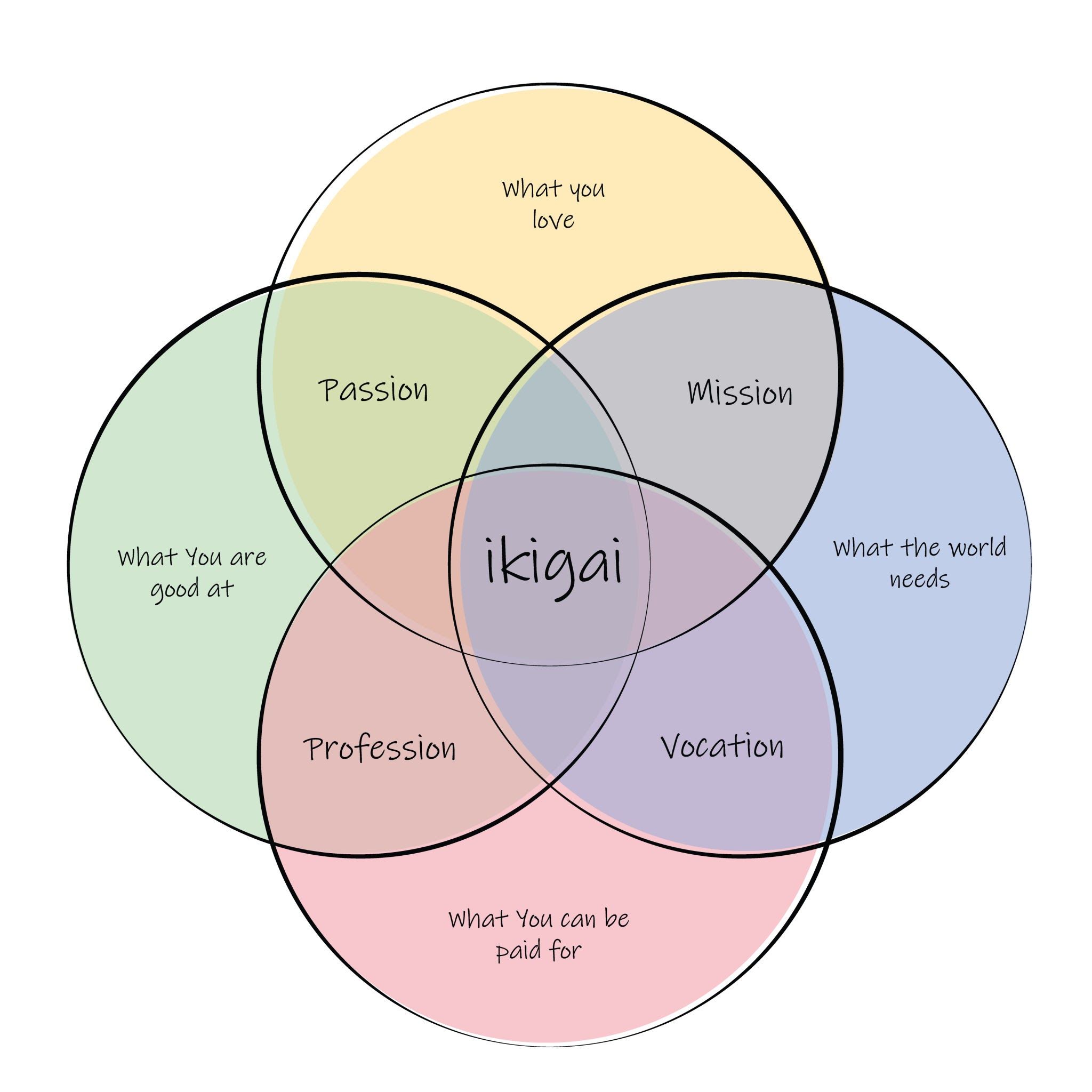
I found the IKIGAI simple picture very relevant in this context. Let me give it a spin.
The Missing Data: The Natal Chart
My HR years gave me a competitive edge. I was in the middle of a lot of relevant reviews, talents, performance, some super meaningful, some political, some totally bs..., At some point, I started to integrate Vocational Astrology into my work. If the Resume is the history of your survival, the Natal Chart is the blueprint of your architecture. Your Birth Chart is not just a horoscope. It is a complex data map of your internal operating system. It reveals the factory settings of your psyche before the world told you who you "should" be. When I look at a chart, I am looking for the source of your Resonance.
- The Sun: Your engine. What fuels you? (e.g., A Leo Sun runs on creative expression and recognition. A Virgo Sun runs on service and optimization).
- The Moon: Your safety. What do you need to feel secure? (e.g., A Cancer Moon needs emotional connection. An Aquarius Moon needs intellectual freedom).
- The Midheaven (MC): Your legacy. What are you here to build? (e.g., A Capricorn MC is here to build structures. A Pisces MC is here to bring vision/healing).
A Case Study: The "Failed" Finance Director
Let me give you a concrete example. I worked with a client—let's call him Michael. Michael was a Finance Head. His CV was incredible: 15 years of crushing targets, aggressive growth, and team leadership. But Michael was miserable. He was suffering from chronic anxiety and hated waking up in the morning. He thought he was "weak." He felt "insecure". We looked at his Chart.
- His Resume said: Aggressive Hunter, Closer, Leader.
- His Chart said: Sun in Libra (The Diplomat), Mars in Cancer (The Protector), Midheaven in Cancer (The Caregiver).
Michael wasn't a "Hunter." He was a "Nurturer." He had succeeded in in his role because he was so good at caring for his clients (Cancer) and harmonizing the deals (Libra). But the aggressive, cut-throat environment of the organization (a lot Fire energy) was assaulting his sensitive nature every single day. He was using his skills (Competence) to fight against his nature (Resonance). The Pivot: We didn't throw away his CV. We just realigned it. He didn't need to quit business to become a monk. He just needed to stop being a "Hunter. "He moved into Client Success & Account Management. In this new role, his job was to nurture existing relationships, protect the client’s interests, and ensure long-term harmony. Same industry. Similar salary. But suddenly, the work was feeding his Mars in Cancer. The anxiety vanished. Now...there is of course no "ultimate" recipe for success and there is no "one size fits all". As we know, context matters. But reflect on this versus where you are today.
The Bi-Focal Approach: How to Calibrate
This is the core of the CareerXpanse methodology. We use a Bi-Focal approach.
Lens 1: The HR Expert (The Resume) We respect the market. We acknowledge the skills you have built. We ensure that whatever move you make is financially viable and strategically sound. We look at your "Hard Skills."
Lens 2: The Astrologer (The Chart) We respect the soul. We acknowledge your energetic needs. We identify the cosmic timing (Transits) to ensure you aren't swimming upstream. We look at your "Hard Wiring."
Stop Hiring Your Past
If you are feeling lost, it is likely because you are trying to solve a puzzle with half the pieces. You are staring at your resume, trying to rearrange the bullet points to find happiness.You won't find it there. The resume is a map of where you have been.To find where you are going, you need a different map. You need to understand not just what you can do, but who you are. It is time to stop interviewing for your past and start interviewing for your future.
Are you ready to see the full picture?Let’s put your Resume and your Chart side-by-side and see where the gap is.